

Pump listings throw a lot at you: GPH, horsepower, head height, outlet size, solids handling, hose compatibility, and sometimes a chart that looks like it belongs in an engineering textbook. Here is how to read the specs that actually matter, so you do not buy the wrong tool for the job.
Key Takeaways
- GPH tells you how much liquid a pump can move under ideal conditions.
- Head height tells you how high the pump can push water, but flow drops as height increases.
- Solids handling tells you the size of particles the pump is designed to pass without clogging.
- Hose size, distance, bends, and elevation all affect real-world flow.
- The right pump is not always the biggest pump. It is the pump that matches your tank, distance, lift, liquid, and workflow.
Pump specs can feel like a numbers contest. Bigger GPH. Bigger horsepower. Bigger claims.
But a pump is only useful if it works in your actual setup. Moving water from a tank to a nearby bed is not the same as pushing nutrient solution uphill, through a long hose, around bends, and out through a wand.
That is where specs start to matter.
This guide explains GPH, head height, and solids handling in plain language. If you are planning a full watering or feeding setup, keep this article paired with the full Plant Feeding and Watering Guides.
The Three Pump Specs That Matter Most
Pump listings often include a long spec list, but three numbers usually tell you the most about fit:
GPH
Gallons per hour. This tells you how much liquid the pump can move under easy conditions.
Head Height
The vertical height a pump can push liquid. This is one of the most misunderstood pump specs.
Solids Handling
The particle size the pump is designed to pass without clogging the impeller or internal pathway.
You need all three together. A high-flow pump that cannot handle your lift may disappoint you. A pump that handles solids but moves too slowly may waste your day. A pump with the right motor but the wrong hose setup may never deliver the flow you expected.
The simple rule: do not buy based on one big number. Match the pump to the whole job.
What GPH Means
GPH stands for gallons per hour. It tells you how much liquid a pump can move in an hour under the conditions used for that rating.
For example, if a pump is rated at 5,000 GPH, that does not automatically mean you will get 5,000 gallons per hour through your hose in your garden. That number is usually the pump’s upper-end flow rating, often measured under easier conditions with little or no vertical lift and less restriction than a real-world setup.
Why GPH can be misleading by itself
GPH drops when the pump has to work harder.
Flow can drop because of:
- Vertical lift
- Long hose runs
- Small hose diameter
- Sharp bends or kinks
- Restrictive fittings
- Spray wands or nozzles
- Thicker nutrient solutions
- Sediment or solids in the liquid
That is why GPH is useful, but it is not the whole story. It tells you the pump’s flow potential. Head height and setup resistance tell you how much of that flow you are likely to keep.
GPH vs. GPM
Some pump listings use GPH. Others use GPM, which means gallons per minute.
The conversion is simple:
GPM x 60 = GPH
GPH ÷ 60 = GPM
A pump rated at 3,000 GPH is moving up to 50 GPM under its rated conditions. A pump rated at 5,120 GPH is moving up to about 85 GPM under its rated conditions.
In a garden or grow setup, that difference can matter. Higher flow can help you drain, transfer, or feed faster, but only if the rest of the setup can support it.
Pump Head Height Explained
Head height is the vertical distance a pump can push water upward.
If your pump is sitting in a tank and needs to push water up to a bench, through a hose, or into an elevated area, head height matters. The higher the pump has to lift the water, the harder it works.
Here is the part people miss: maximum head does not mean maximum working flow.
A pump may list a maximum head height, but at or near that maximum height, flow may be very low. In many cases, maximum head is closer to the point where the pump can barely push liquid that high, not the height where it delivers strong flow.
Think of head height like a hill: the steeper and taller the climb, the slower the pump moves liquid.
Static head vs. total head
Static head is the simple vertical lift from the liquid surface to the discharge point. If water starts in a tank and exits 6 feet higher, your static head is about 6 feet.
Total head is the real-world workload. It includes vertical lift plus friction from hoses, fittings, bends, valves, and attachments.
That means a pump pushing water 6 feet up through a short, wide, straight hose has an easier job than a pump pushing water 6 feet up through 100 feet of smaller hose with tight bends and a wand on the end.
Why head height changes flow
Pumps have a tradeoff between flow and head. As head goes up, flow goes down. That is why pump curves exist. They show how much flow a pump can deliver at different head heights.
If a listing gives you a pump curve, use it. Look for the head height closest to your setup, then check the flow at that point.
How to Estimate the Head Height You Need
You do not need to be an engineer to make a better pump choice. Start with a practical estimate.
Step 1: Measure the vertical lift
Measure from the surface of the water in the tank to the highest point where the water needs to go.
Example:
- Tank water level to floor: 0 ft
- Floor to raised bench: 3 ft
- Bench to highest discharge point: 2 ft
- Estimated static head: 5 ft
Step 2: Add friction from the setup
Long hoses, narrow hoses, elbows, fittings, valves, and wands all add resistance.
You do not need a perfect friction-loss calculation for a basic garden setup. Just know this: the more restriction you add, the more flow you lose.
Step 3: Leave room in the pump
Do not choose a pump that barely meets your estimate. If you need water to move with decent force at 8 feet of lift, do not buy a pump that only looks good at 8 feet under perfect conditions.
Give yourself margin. Your future self will thank you when the hose is longer than planned, the tank is lower than expected, or the liquid is thicker than plain water.
What Solids Handling Means
Solids handling tells you the size of particles a pump is designed to pass.
This matters when you are moving more than clean water. Garden and grow setups can include organic nutrients, sediment, soil particles, undissolved material, biological inputs, and tank residue.
If a pump is not designed to handle solids, small particles can clog the impeller, slow the pump, or stop the job halfway through.
What “handles solids up to 1/4 inch” means
If a pump says it handles solids up to 1/4 inch, that means it is designed to pass particles up to that size through the pump pathway.
That does not mean you should intentionally throw chunks into the tank and let the pump eat them. Solids handling is protection against normal debris, sediment, and nutrient material. It is not permission to skip mixing, straining, or cleaning when your routine needs it.
Built to handle solids does not mean built to handle neglect. Keep the tank mixed, avoid oversized debris, and clean the system between uses.
Why solids handling matters for nutrient solutions
Nutrient solutions are not always perfectly clean. Some inputs dissolve fast. Others leave sediment. Organic mixes can be thicker and more variable than plain water.
If your pump is only comfortable with clean water, solids can turn a quick transfer job into a clog-and-clean session. That is why solids handling should be part of the decision when you are moving nutrient solution, not just draining clear water.
How Hose Size Affects Pump Performance
A pump can only move what the hose lets through.
If you connect a high-flow pump to a narrow or restrictive hose, you can choke down the flow. The pump may still run, but you are not getting the full benefit of the motor.
Hose setup matters because of:
- Inside diameter
- Hose length
- Kinks
- Fittings
- Valves
- Nozzles and watering tools
Wider hoses usually allow higher flow with less restriction. Shorter hose runs are easier on the pump than long runs. Smooth, open fittings usually move water better than tight adapters and sharp bends.
Horsepower Is Not the Whole Story
Horsepower tells you something about the motor, but it does not tell you everything about pump performance.
A higher-horsepower pump can often move more water or handle tougher jobs, but design still matters. Impeller style, outlet size, solids handling, head rating, and hose compatibility all affect real-world results.
Do not shop by horsepower alone. Use it as one clue, then check the rest of the specs.
How to Read a Pump Listing Without Getting Burned
When you are comparing pumps, do not just scan for the biggest flow number. Read the listing like a job match.
| Spec | What It Means | What to Ask Before Buying |
|---|---|---|
| GPH or GPM | How much liquid the pump can move under rated conditions. | Will I still get enough flow after lift, hose length, and restrictions? |
| Head Height | How high the pump can push liquid vertically. | How far up does the water need to travel in my setup? |
| Solids Handling | The particle size the pump is designed to pass. | Am I moving clean water, nutrient solution, sediment, or organic inputs? |
| Outlet Size | The connection size for the discharge side of the pump. | Does it match my hose, fittings, and watering tools? |
| Submersible vs. External | Whether the pump is designed to sit in the liquid or operate outside the tank. | Where will the pump sit during use? |
| Clean Water vs. Utility Use | Some pumps are built for clean water only, while others can handle tougher transfer jobs. | Will this pump handle the liquid I actually need to move? |
Example: Reading Specs for a Garden Transfer Pump
Say you need a pump to move nutrient solution from a feed tank to a garden area.
Your setup looks like this:
- 100-gallon feed tank
- 25 to 50 ft hose run
- 3 to 5 ft of lift
- Some sediment from mixed nutrients
- You want faster feeding, not a slow trickle
In that case, you would care about more than horsepower. You would want strong flow, enough head capacity for the lift, hose compatibility, and solids handling for the solution you are moving.
A small clean-water pump may look fine on paper, but it may clog, slow down, or struggle once real nutrient solution is involved.
Common Pump Spec Mistakes
Buying based only on maximum GPH
Maximum GPH is helpful, but it is not a promise that your setup will move that much water. Lift, hose length, fittings, and restrictions reduce flow.
Ignoring head height
If your pump has to push water uphill, head height matters. A pump that works great at floor level may struggle once the discharge point is higher.
Using the wrong hose
A restrictive hose can hold back a strong pump. Make sure your hose diameter, fittings, and attachments support the flow you want.
Assuming all pumps handle nutrients
Some pumps are designed for clean water. Nutrient solution can bring solids, residue, and thicker material. Check solids handling before assuming the pump is ready.
Thinking bigger is always better
Too much flow can be hard to control, especially in smaller tanks or delicate watering situations. The goal is the right pump, not just the biggest pump.
Quick Sizing Checklist
Before you choose a pump, write down the real job.
Know your tank
- How many gallons are you moving?
- Are you draining, transferring, feeding, or circulating?
- Is the liquid clean water or nutrient solution?
Know your distance
- How far does the liquid need to travel?
- How much vertical lift is involved?
- Will the hose run uphill, downhill, or both?
Know your restrictions
- What hose size are you using?
- How many fittings, bends, valves, or nozzles are in the line?
- Will you use a watering wand or attachment?
Know your liquid
- Is it plain water?
- Does it include synthetic nutrients?
- Does it include organic material, sediment, or solids?
- Does the pump need solids-handling capacity?
When to Choose a Higher-Flow Pump
A higher-flow pump makes sense when speed and volume matter.
Look at a higher-flow option when:
- You are moving larger tanks of water or nutrient solution
- You want to reduce transfer time
- You are feeding multiple zones
- You are draining pools, reservoirs, or larger containers
- Your setup includes moderate hose length or lift
- Your liquid may include sediment or nutrient solids
Bigger flow is not just about speed. It can also help you keep work moving when the setup adds resistance.
When a Smaller Pump May Be Enough
A smaller pump can be the better fit for simple jobs.
Look at a smaller option when:
- Your tank is small
- Your hose run is short
- There is little vertical lift
- You are moving mostly clean water
- You need easier control over flow
- You do not need to move large volumes quickly
If the setup is compact and the liquid is clean, you may not need more pump than the job calls for.
How This Fits Into a Better Watering Routine
Pump sizing is part of the larger feeding and watering system.
The pump moves the liquid. The hose controls how easily it flows. The fittings, valves, and attachments shape how that flow behaves. The tank routine determines how clean and consistent the liquid is before it ever reaches the pump.
A better setup comes from matching all of it:
- Start with the tank size and water source
- Decide how fast the liquid needs to move
- Measure the lift and distance
- Choose hose and fittings that support the flow
- Check solids handling if nutrients or sediment are involved
- Choose a pump with room to work
Need a pump that matches the job?
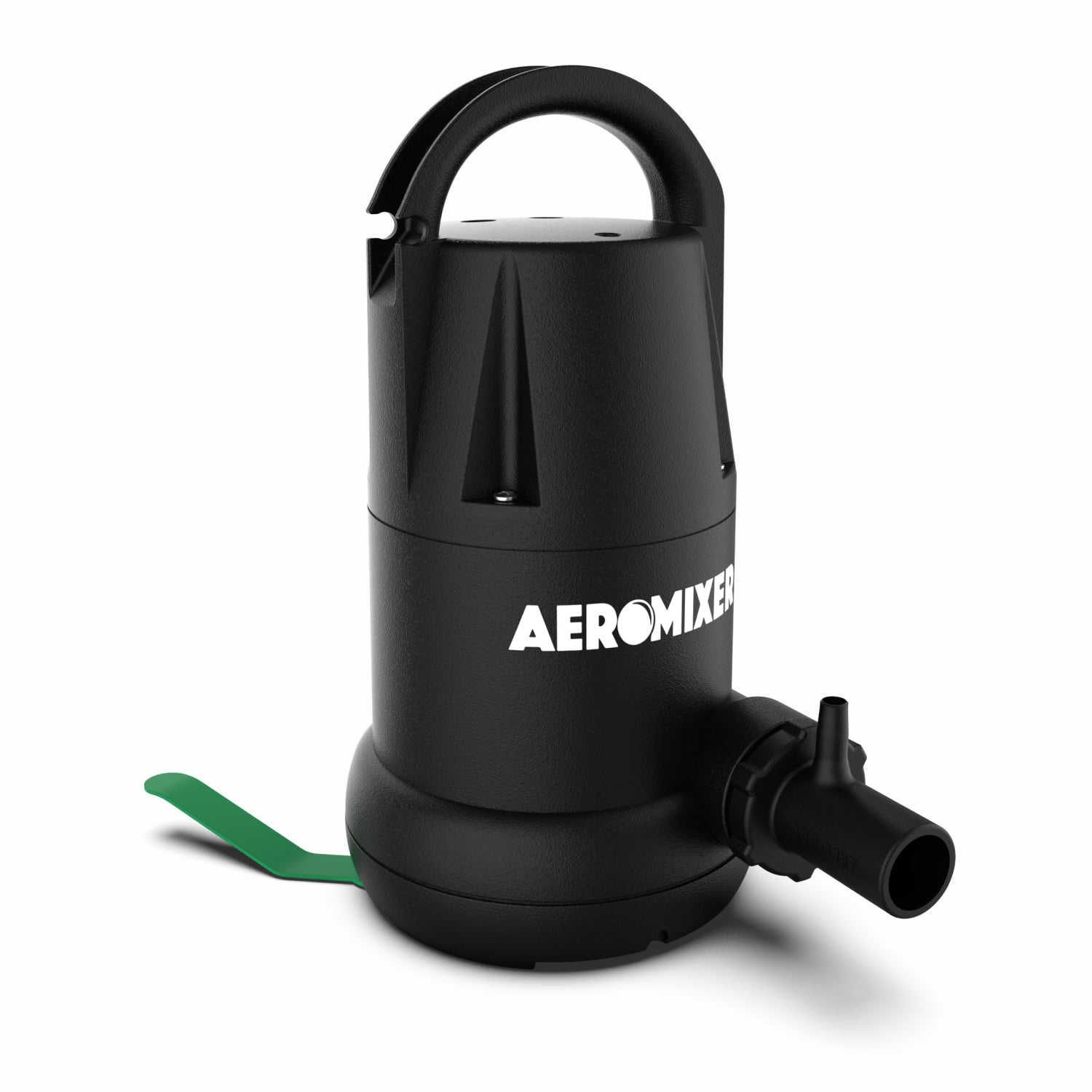
If your next step is choosing a pump for water transfer, nutrient movement, draining, or garden feeding, the most relevant product hub is the Aeromixer pumps collection. Start there to compare pump options and choose the setup that fits your tank, flow, and workload.
Explore the Pumps HubQuick FAQ
What does pump head height mean?
Pump head height means the vertical height a pump can push liquid. In real use, higher head usually means lower flow, so maximum head should not be treated like normal working flow.
Is higher GPH always better?
Not always. Higher GPH can save time when you are moving larger volumes, but smaller setups may need more control instead of more flow. Match the pump to the tank, hose, lift, and liquid.
Why does my pump move less water than the listing says?
Listings often show flow under easier rated conditions. Real-world flow drops when the pump has to push uphill, move through long hose runs, pass through narrow fittings, or handle thicker liquid.
What does solids handling mean on a pump?
Solids handling tells you the particle size the pump is designed to pass. This matters when you are moving nutrient solution, sediment, organic inputs, or water that is not perfectly clean.
How do I know what size pump I need?
Start with tank volume, desired transfer speed, vertical lift, hose length, hose size, and the type of liquid you are moving. Then choose a pump that gives you enough flow after those real-world restrictions.
The Takeaway
Pump specs are not just numbers on a product page. They tell you how the pump will act once it hits real work.
GPH tells you flow potential. Head height tells you how lift affects that flow. Solids handling tells you whether the pump is ready for more than clean water.
Read those specs together, then look at your tank, hose, distance, lift, and liquid. That is how you avoid the wrong pump and build a setup that actually works.
Keep learning with the full Plant Feeding and Watering Guides, or compare water-transfer options in the Aeromixer Pumps Hub.